Putting State Dollars to Work: How Governors' Signature Investments Drive Workforce Transformation

Updated: Jun 25
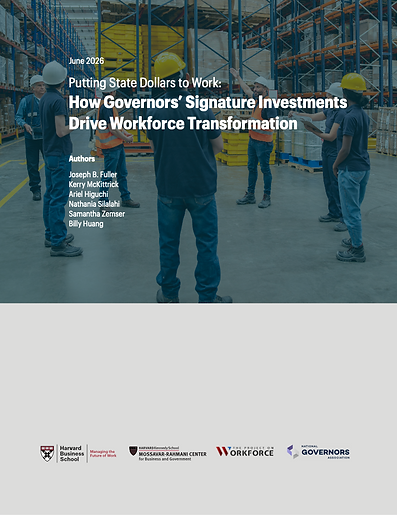
Authors: Joseph B. Fuller, Kerry McKittrick, Ariel Higuchi, Nathania Silalahi, Samantha Zemser, Billy Huang
National Governors Association partners: Sophia Yager, Malena Dailey, Jack Porter
Overview
Governors occupy a distinct position in the American workforce development ecosystem, influencing how both federal and state workforce dollars are deployed. Many Governors are using state-funded workforce investments to address labor shortages, support economic development priorities, and strengthen education-to-employment pathways.
This report examines Governors’ “signature workforce investments” across five states: North Dakota, Minnesota, Idaho, Massachusetts, and Wyoming. Drawing on interviews with 45 stakeholders spanning Governors’ offices, state agencies, workforce organizations, higher education institutions, and industry, the report explores how those initiatives were designed, funded, implemented, and adapted over time.
The report highlights several cross-state insights:
Programs navigated tradeoffs between broad eligibility and strategic targeting.
Programs engaged with the WIOA system while developing independent eligibility frameworks.
Programs successfully tracked short-term metrics and are building toward longer-term outcomes tracking, despite operational challenges.
Programs evolved after launch as states adapted to implementation realities, refining design, addressing gaps, and responding to stakeholder needs.
Governor-led workforce investments are building on existing systems to drive change in how stakeholders coordinate and operate.
State Case Studies
North Dakota - Regional Workforce Impact Program (RWIP)
RWIP funded locally defined workforce solutions across geographic regions, supporting projects related to child care, workforce training, talent attraction, and sector partnerships.
Minnesota - Drive for 5
Drive for 5 supports structured training-to-employment pipelines across five high-growth industries through partnerships among employers, training providers, chambers of commerce, and workforce organizations.
Idaho - Student LAUNCH
Student LAUNCH provides graduating high school seniors up to $8,000 for education and training aligned with Idaho’s in-demand careers list.
Massachusetts - MassReconnect
MassReconnect provides last-dollar financial aid to make community college tuition-free for Massachusetts adults age 25 and older who have not yet earned a college degree.
Wyoming - Wyoming Innovation Partnership (WIP)
WIP supports workforce development, innovation, and economic diversification through collaborative grants across Wyoming’s public higher education institutions.
Policy Opportunities
The report concludes with a discussion of policy opportunities related to:
• Program design and implementation
• Workforce governance and coordination
• Funding structures and sustainability
• Workforce data systems and metrics tracking
Please direct inquiries to: Kerry McKittrick (kerry_mckittrick@gse.harvard.edu)
Suggested Citation: Joseph B. Fuller, Kerry McKittrick, et al. (June 2026). Putting State Dollars to Work: How Governors' Signature Investments Drive Workforce Transformation. Published by the Harvard Kennedy School.